What It Really Takes to Stabilize a Legacy Software Project
Inheriting a legacy software project means inheriting years of undocumented decisions, tribal knowledge and delivery habits that no longer scale. How Enouvo stabilized a long-running product without a rewrite and without pausing delivery.
Taking over an existing software product sounds easier than building one from scratch. The code already works. Users already rely on it. The hard decisions have already been made.
In practice, inheriting a legacy software project often means inheriting years of undocumented decisions, fragmented knowledge, and delivery habits that no longer scale. The system runs - but nobody can say with confidence why certain parts behave the way they do, or what will break if you touch them.
At Enouvo, we have taken over and stabilized long-running products, and one lesson stands out: stabilization is rarely a coding problem. It is a knowledge, process, and communication problem that happens to involve code. This article walks through how we approach it, drawn from a recent engagement, and what we believe any team inheriting a legacy system should focus on first.
Why legacy software projects become difficult
Legacy systems rarely start out difficult. They become difficult gradually, as the ecosystem around the code stops evolving at the same pace as the code itself.
The symptoms are remarkably consistent across products and industries:
- Undocumented systems. Architectural decisions, business rules, and workarounds live only in the code - and in the memories of whoever wrote them.
- Tribal knowledge. A small number of people hold critical contexts. When they change roles or leave, that context leaves them.
- Unclear ownership. As teams rotate, it becomes harder to say who is accountable for a module, a decision, or a release.
- Inconsistent communication. Information flows through fragmented channels - some decisions in chat, some in email, some never written down at all.
- Accumulated technical debt. Reasonable shortcuts, taken under real deadline pressure, compound over years into structures nobody would design deliberately.
None of these are signs of a bad team. They are the natural result of years of shipping under pressure, of people moving on, of priorities shifting. Entropy is the default state of any long-running software project. The real question is not whether these patterns appear - it is whether anyone addresses them deliberately before they start dictating the pace of delivery.
The engagement: joining a product mid-journey
When Enouvo joined an ongoing software product - one that had been in active development for years and had already passed through more than one team - the mandate was twofold: keep delivering the features the business needed and make the product easier and safer to change.
There was no pause button. Users were active, the roadmap was live, and the business could not afford a delivery freeze while the new team “got up to speed.” Whatever we did to stabilize, the project had to happen alongside ongoing delivery, not instead of it.
That constraint shaped everything that followed.
The challenges we walked into
The situation we found will be familiar to anyone who has managed a long-running product. These were not failures of any individual or organization - they were the accumulated cost of years of evolution without dedicated investment in knowledge and process.
Limited documentation. Onboarding meant archaeology: reading code, asking around, and testing assumptions by trial and error. Every new question required reconstructing context from scratch, which made even small changes slower and riskier than they should have been.
Knowledge transfer gaps. Previous handovers had been compressed by circumstances, and each transition lost a layer of context. What remained was a system that worked, attached to an incomplete explanation of why.
Legacy source code. The codebase carried patterns from several different eras of development. Changes had an unpredictable blast radius, which made estimation difficult - and unreliable estimates are one of the fastest ways to erode trust in a delivery team.
Fragmented domain knowledge. Each person held a piece of the domain picture, but no one held it all. Cross-cutting decisions required assembling context from multiple people, which slowed everything from refinement to release sign-off.
Inconsistent delivery practices. Release processes varied from cycle to cycle. Without a stable, repeatable path to production, every release carried its own unidentified risk.
From a project management perspective, these challenges compound each other. Every estimate carries hidden uncertainty. Every release carries unmeasured risk. Every client's conversation requires reconstructing context before it can move forward. The cost of a legacy software project is rarely visible in the code - it is visible in the calendar.
How we approached stabilization
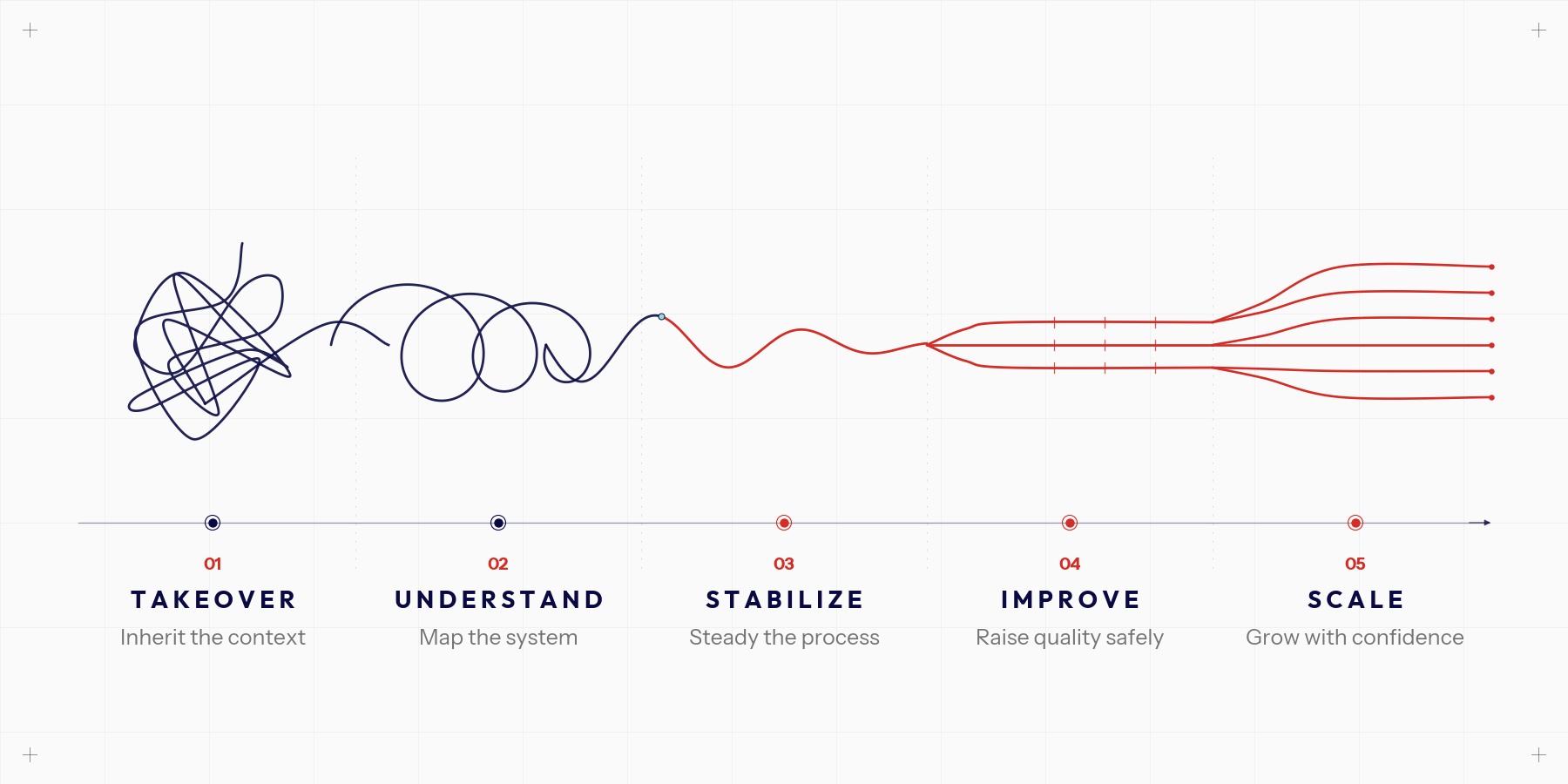
The first decision was what not to do: we did not propose a rewrite.
Rewrites are tempting because they promise a clean slate. In practice, they discard years of embedded business knowledge, freeze feature delivery for months, and carry a well-documented failure rate. A legacy system is not just old code - it is the most complete record of the business rules that exist. Throwing it away means rediscovering those rules the hard way.
Instead, we followed a deliberate progression - takeover, understand, stabilize, improve, scale - built on six working practices.
1. Understand before changing anything
The first weeks were spent mapping the system: architecture, module boundaries, integrations, data flows, and the deployment pipeline. Reading code was only part of this. The bigger part was reconstructing intent - treating every surprising piece of code as a decision we did not understand yet, rather than a mistake to be corrected. That posture matters. It keeps the team curious instead of dismissive, and it regularly turns “this looks wrong” into “this handles an edge case we didn't know existed.”
2. Make documentation a working tool, not an afterthought
We documented as we learned: architecture overviews, domain glossary, operational runbooks, and lightweight decision records. The operating rule was simple — if answering a question took real effort, the answer got written down. Documentation produced this way stays accurate because it is created at the moment of understanding, not scheduled for a “later” that never comes.
3. Build knowledge sharing into the routine
Documentation alone does not spread understanding; habits do. We paired engineers on unfamiliar modules, ran internal walkthroughs of complex areas, and rotated ticket ownership so that knowledge would not re-concentrate in one or two people. Onboarding became our ongoing test: if a new team member could not get productive from the documentation and a few structured sessions, that was a gap to fix — not a rite of passage to preserve.
4. Restructure communication - and bring QA inside it
We consolidated decisions into a single source of truth and established a steady communication cadence with the client: regular demos, a shared view of priorities, and early flagging of risks. Just as importantly, QA joined client discussions and backlog refinement directly. Once testers understood the business intent behind each ticket, testing shifted from “does this match the description?” to “does this solve the actual problem?” - and issues started surfacing earlier, where they are cheapest to address.
5. Make delivery visible and predictable
We standardized the path to production: a clear definition of ready and done, a consistent release checklist, disciplined use of staging environments, and a demo rhythm the client could rely on. Predictability is the currency of trust in software delivery. When the client can see what is in progress, what is at risk, and what will ship next, conversations shift from status-chasing to genuine planning.
6. Improve incrementally, alongside business value
Technical improvement was folded into feature work rather than scheduled against it. When we touched a module, we left it better than we found it - clearer naming, added tests, small refactors, updated docs. Paying down technical debt this way is slower per module than a dedicated overhaul, but it compounds continuously and never stops delivery. Each release shipped both business value and a slightly safer codebase.
What changed
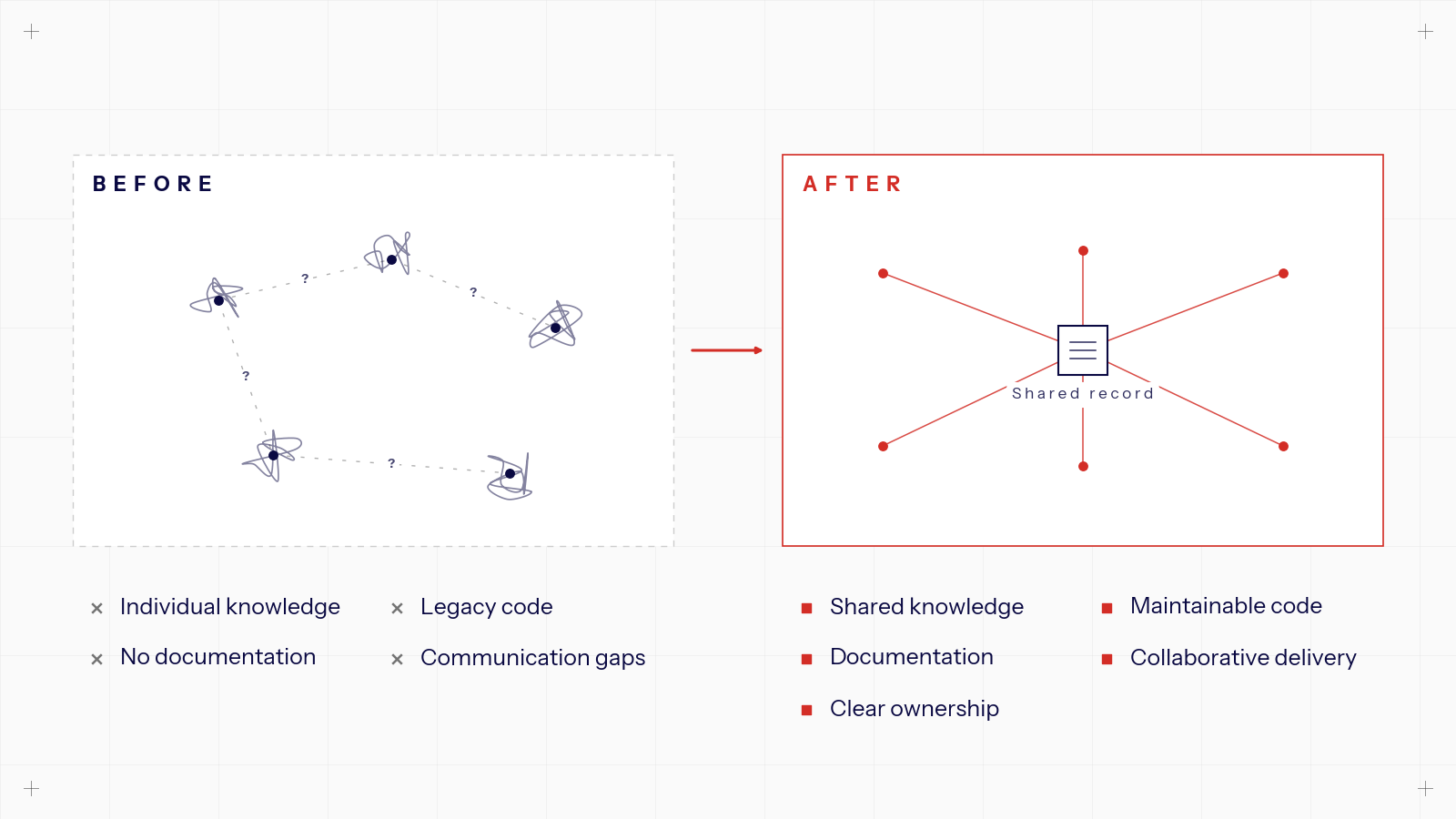
Stabilization is measured in months, not sprints, and none of these shifts happened overnight. But the trajectory became unmistakable:
- Onboarding improved. New team members followed a structured path instead of weeks of archaeology.
- Collaboration deepened. Developers, QA, project management, and the client worked from a shared picture instead of separate ones.
- Delivery risk dropped. A consistent release process and earlier QA involvement meant fewer surprises close to production.
- Release confidence grew. Releases became routine events rather than sources of anxiety.
- Knowledge transfer accelerated. Understanding of the system stopped depending on specific individuals.
- The codebase became more maintainable. Incremental refactoring made each change safer than the last.
The clearest signal of progress was a change in the questions the team asked. “Who knows how this works?” gradually became “where is this documented?” - and increasingly, the answer already existed.
What we learned
Legacy systems rarely fail because they are old. They become difficult because knowledge, processes, and ownership stop evolving. Code can survive years of change - but only if the understanding of it survives too.
The second lesson is that delivery practices are engineering practices. Documentation, communication structure, and release discipline determine whether code can be changed safely, just as much as the code's internal quality does. Engineering management that treats these as secondary concerns ends up paying for them in delivery risk.
The third is that stabilization does not require pausing delivery. Every improvement described here landed alongside feature work. In fact, delivering features is how a team learns a legacy system fastest - carefully, with each change deepening the shared understanding of how the product actually works.
Looking ahead
Organizations with long-running products do not always need to rewrite. More often, they need a partner who can understand what is already there, reduce delivery risk, and help the existing product - and the people around it - move forward with confidence.
Modernization, in our experience, is not an event. It is a discipline: the steady practice of keeping knowledge, processes, and code evolving together. Teams that build that discipline can keep a product healthy for another decade. Teams that skip it will face the same stabilization challenge again, whatever technology they rewrite in.
If you are weighing what to do with a legacy software project - takeover, stabilization, or modernization - we are glad to share how we approach it. Talk to the Enouvo team.
About the author
Khanh Nguyen is a Scrum Master at Enouvo IT Solutions who manages delivery across a wide range of client projects - from MVP product builds to long-running enterprise systems. The legacy takeover described in this article is one of the projects she has led, working closely with engineering, QA, and client teams to rebuild documentation, delivery processes, and knowledge sharing on an inherited codebase. This article reflects practical experience from production client work.