Inside Enouvo AI Devkit: Transforming the Software Development Lifecycle
Most teams now write code alongside an AI assistant. Far fewer have figured out how to do it consistently, safely, and at the quality their clients expect. That gap is exactly the problem Enouvo set out to solve when we built our own AI DevKit.
Most teams now write code alongside an AI assistant. Far fewer have figured out how to do it consistently, safely, and at the quality their clients expect. That gap is exactly the problem Enouvo set out to solve when we built our own AI DevKit. Here's the story of why we built it, what it does, and how it changes the way we deliver software. The DevKit is also the first publicly released component of the Enouvo Agentic Platform — a larger, in-house AI-native delivery system the team is building and maintaining — with more to follow in the months ahead.
Key Takeaways
- In 2025, most developers reported using or planning to use AI tools, but only 29% trust their accuracy (Stack Overflow Developer Survey 2025).
- Enouvo's AI DevKit turns ad-hoc AI use into a standard, reviewable workflow built on Claude Code and Codex.
- A companion gateway, AI Proxy, gives every engineer secure model access through Microsoft single sign-on, with no exposed API keys.
- The result is more predictable delivery: planning before code, built-in review, and real tests on every task.
- In our internal benchmark, teams using the DevKit improved AI-assisted delivery efficiency by up to 87% versus ad-hoc AI use.
Why is AI-assisted software development so hard to get right?
The hard part isn't adoption anymore; it's consistency and trust. In 2025, 90% of technology professionals reported using AI in their daily work, up 14% from the year before (DORA 2025, State of AI-assisted Software Development). However, that same year, developer trust in AI output fell to a record low.
Consider the numbers behind that drop. The Stack Overflow Developer Survey 2025, with more than 49,000 responses, found that 46% of developers distrust the accuracy of AI output, nearly double the 31% from a year earlier (Stack Overflow, 2025). The top frustration, named by 66% of developers, was AI solutions that are "almost right, but not quite." In fact, another 45% said debugging AI-generated code takes longer than writing it themselves.
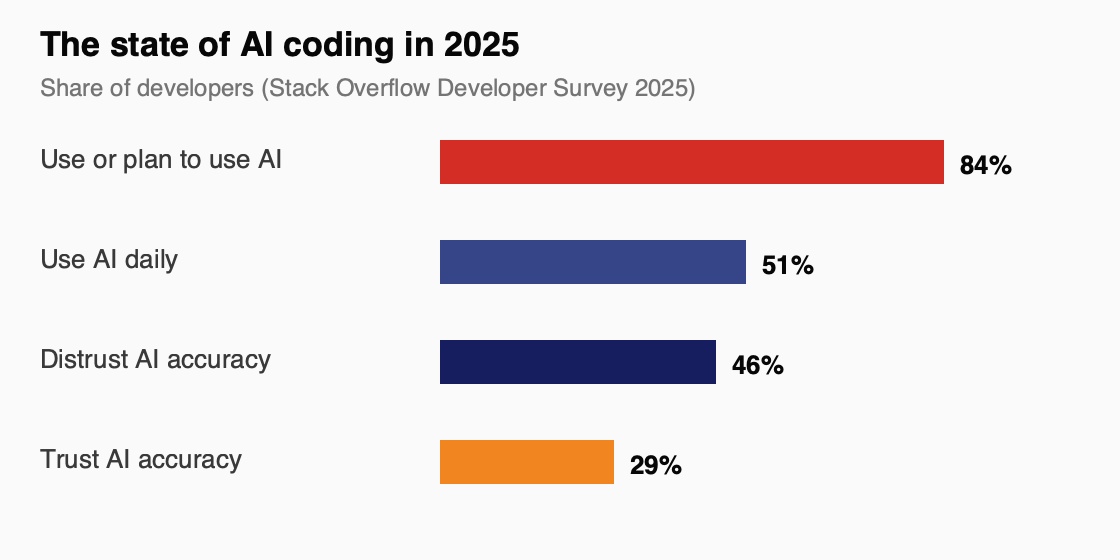
That, in short, is the real challenge. AI makes any individual feel faster, but the gains are uneven: in a 2025 randomized trial, METR found experienced developers were actually 19% slower with AI on code they knew well, even while believing they were faster (METR, 2025).
Speed without structure also erodes quality. GitClear's analysis of 211 million changed lines found copy-pasted code climbed to 12.3% of all changes while properly refactored code fell (GitClear, 2025), so the real bottleneck shifts from writing code to reviewing and maintaining it. When every engineer uses AI differently, a team's output becomes a lottery. So the question we kept asking was simple: how do you keep the speed and lose the lottery?
Why did Enouvo build its own AI DevKit?
We built it because AI amplifies whatever process you already have, good or bad. The DORA 2025 report put it plainly: AI doesn't fix a team, it magnifies its existing habits (DORA, 2025). In particular, that same report identified a clear AI policy and a quality internal platform among the capabilities that turn AI adoption into real gains.
What we saw: Across our project teams, AI assistants were everywhere, but the practices around them weren't. One engineer planned carefully before generating code; another shipped whatever the model produced first. Review depth, test discipline, and documentation all varied by person. The tools were powerful. The outcomes weren't predictable.
Accordingly, instead of leaving each engineer to invent their own approach, we encoded our standards into a shared toolkit. In practice, the AI DevKit makes the right way the default way: plan first, review before merging, write real tests, document as you go. As a result, every developer, junior or senior, gets the same disciplined workflow on top of the AI tools they already use.
What is the Enouvo AI DevKit?
The Enouvo AI DevKit is a shared toolkit that brings structured, multi-agent workflows to Claude Code and Codex. A single command installs it into any project, where it adds specialized AI agents, domain skills, and quality automation that the whole team uses the same way.
The DevKit is the first released component of the Enouvo Agentic Platform — a broader, in-house initiative for AI-native software delivery that the team builds and maintains. It represents the practitioner layer of that platform; a fuller picture of the platform's architecture and capabilities will follow in the months ahead.

Specifically, it ships 16 specialized agents spanning planning, research, implementation, debugging, testing, code review, security, database, performance, and UI/UX work, plus more than 80 skills that package reusable engineering knowledge across frontend, backend, testing, and security. Rather than one general assistant guessing at everything, the right specialist handles each part of the job, then hands off to the next. Why does that matter? Because a focused agent with a narrow brief makes fewer of the confident, wrong guesses that erode trust.
Two quieter layers keep that discipline consistent. Shared rules encode coding standards, file ownership, and verification expectations, so the assistant follows the team's conventions instead of inventing its own. Lifecycle hooks fire at the right moments to inject project context, protect sensitive files, and enforce the workflow, rather than trusting everyone to remember each step.
In addition, it supports the languages and frameworks our teams ship every day, including TypeScript, JavaScript, Python, Java, Go, and Rust, with frameworks such as Next.js, NestJS, Express, FastAPI, Django, and Spring. Because it auto-detects each project's stack, a team in Da Nang and a team elsewhere follow the identical process, in their preferred working language, with the same guardrails.
Two specialized toolkits extend that reach beyond day-to-day coding. QAKit captures page locators and turns user flows into Playwright-based UI and API tests the team can generate, run, and triage, with AI assistance flagging why failures happen. The Presale Kit adds 10 commands for analysis reports, solution blueprints, proposals, handbooks, and case studies, so the same discipline reaches the work that happens before a line of code is written.
How does the DevKit support the full software development lifecycle?
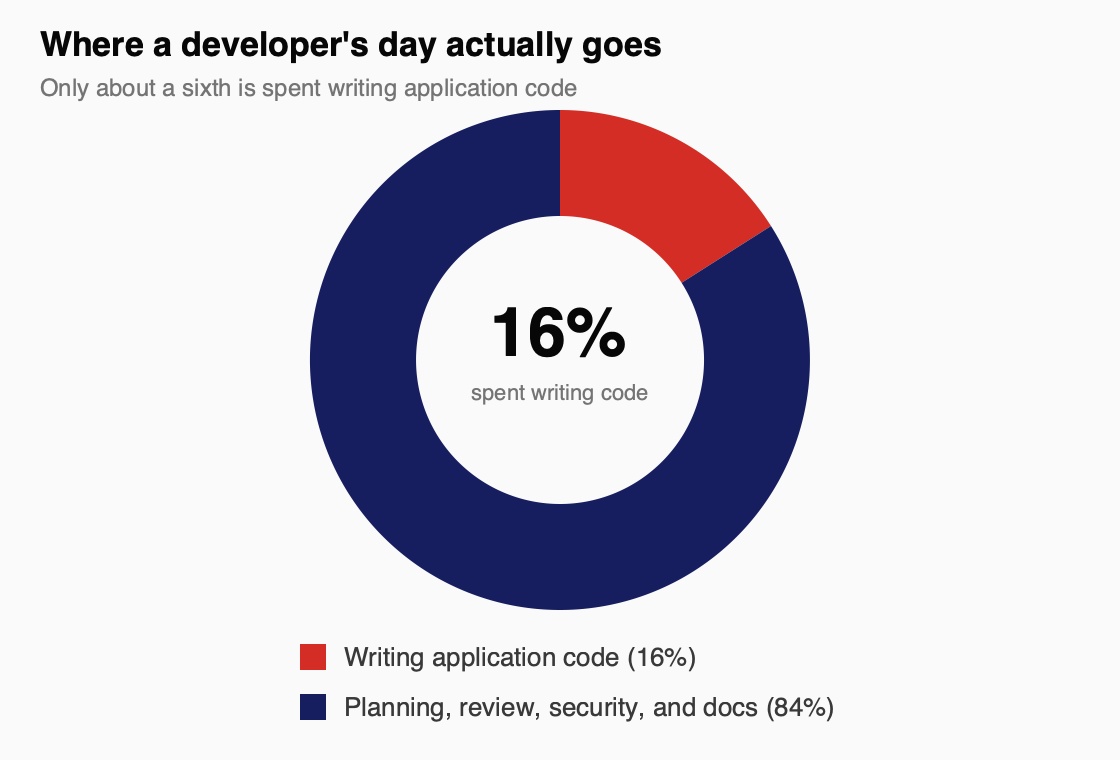
It supports the lifecycle by making planning a required step, not an optional one. That focus matters because coding is only a sliver of the job: IDC found developers spend just about 16% of their time on application development (IDC via InfoWorld, 2025), so most delivery risk lives in the planning, review, and documentation around the code. The DevKit follows a spec-driven development flow that moves an idea through clear phases: capture requirements, generate a plan, review the plan, implement, test, and update documentation. Each phase produces a real artifact the team can read and approve.
Here's how a typical feature moves through it:
| SDLC stage | What the DevKit does | Why it matters |
|---|---|---|
| Discovery and presale | Presale commands produce analysis reports, solution blueprints, and proposals | Early assumptions become written artifacts before they become code |
| Requirements | The assistant asks clarifying questions before any code | Edge cases and constraints surface early, not in QA |
| Plan | Research agents study the codebase, then produce a phased plan | A human reviews intent before work starts |
| Implement | The plan is built phase by phase, as working code | No placeholder stubs to untangle later |
| Review | Specialist agents check code quality, security, performance, and business logic | Multi-dimensional risk gets caught, not just style |
| QA automation | QAKit generates and runs Playwright UI and API tests | Coverage starts as the feature takes shape, not after |
| Debug and document | The debugger finds root cause before fixing; docs stay auto-maintained | Fixes resolve causes, and knowledge stays with the team |
Review in particular deserves a closer look, because quality is multi-dimensional. A change can be cleanly formatted yet still break a business rule, pass its unit tests yet introduce a slow query, or work locally yet expose an authorization gap. By giving each of those concerns its own specialist agent, the DevKit makes the review dimensions explicit instead of hoping one reviewer holds them all in mind.
Debugging works the same evidence-first way. Rather than patching the first symptom, the debugger reproduces the problem, inspects the call paths, tests a hypothesis, and verifies the fix, so the root cause is resolved instead of hidden.
Why does this order matter so much? Because catching a flawed assumption in a five-minute plan review is far cheaper than catching it in production. Therefore, planning before coding is, in our experience, the single habit that prevents the most rework.
What does the DevKit look like in daily work?
A feature rarely starts as code; it starts as a request. For instance, take a typical one: "add usage analytics for admin users." On its own, that sentence hides most of the work. The DevKit's first move is to turn it into the questions that matter: who needs the analytics, which metrics, what date ranges, what permissions, what data already exists, and what should wait for a later version.
That reframing is the whole point, because AI works far better on an explicit, staged task than a vague one. "Build this feature" invites a confident guess; "read these requirements, inspect this module, propose a plan, wait for review, then implement phase one" produces work a human can actually follow and trust.
Once the requirements are clear, the planning workflow inspects the existing codebase and proposes a phased approach: backend data access, API contracts, the dashboard UI, role-based access checks, tests, and documentation. Instead of one long answer, the engineer gets a set of reviewable steps.
During implementation, the assistant handles the repetitive parts, code navigation, test scaffolding, and documentation updates, while the engineer keeps the design decisions and the final call. Before the work counts as done, review agents look at it from different angles: maintainability, security, performance, and whether the result still matches the original intent.
Notably, this is where that 87% gain actually comes from. It isn't AI writing code faster in isolation; it's less repeated setup, fewer unclear handoffs, and stronger artifacts reaching reviewers earlier. Structured AI support doesn't remove human responsibility. It gives humans better material to review, sooner.
What are the key engineering benefits?
The biggest benefit is governed access to AI, paired with consistent quality. That governance comes from a companion system we built alongside the DevKit. AI Proxy is a single secure gateway that routes every engineer's AI requests through Microsoft single sign-on and role-based access, so individual developers never handle raw API keys.
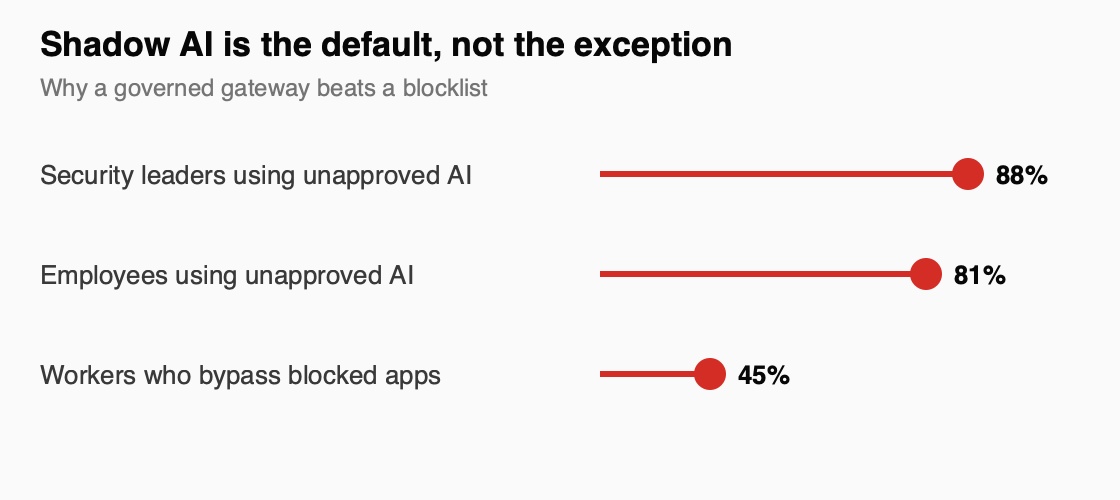
This matters more than it might sound. For example, the most common way teams try to control AI use is to block it outright, and that usually backfires. In 2025, 81% of employees and 88% of security leaders admitted to using unapproved AI tools, and shadow AI already accounted for 20% of data breaches at an average premium of $670,000 per incident (UpGuard State of Shadow AI; IBM Cost of a Data Breach Report 2025). The gap is rarely a policy on paper; it's enforcement. Among organizations that suffered an AI-related breach, IBM found 97% lacked proper AI access controls and 63% had no AI governance policy at all (IBM, 2025). The fix that actually works is making the approved path easier than the unapproved one.
In addition to secure access, the DevKit delivers benefits that compound over time, and the time at stake is real: Atlassian's 2025 developer experience report found half of developers lose 10 or more hours a week to inefficiencies (Atlassian, 2025). Quality gates mean review and testing aren't skipped under deadline pressure. Similarly, multi-agent orchestration splits complex work among specialists. Notably, auto-generated documentation keeps knowledge from walking out the door. Plans, reviews, and test results live on as inspectable artifacts instead of vanishing into chat history. And usage stays visible to the people accountable for it.
What impact does it have on delivery quality and speed?
The impact shows up as fewer surprises late in a project. The DORA 2025 research found that more than 80% of developers believe AI has increased their productivity, but it also warned that AI raises delivery instability when teams lack strong practices around it (DORA, 2025). The DevKit is our answer to that second half: keep the speed, remove the instability.

Our view: The speed AI gives you on the first draft is easy to lose again to debugging and rework. The teams that stay fast are the ones that front-load planning and review. By making both automatic, the DevKit protects the time savings instead of trading them for a longer cleanup later.
As a result, for our clients the practical effects are steadier release quality, faster onboarding for new engineers (who inherit a proven workflow on day one), and clearer traceability from a requirement to the code that fulfills it. Moreover, new team members don't have to absorb years of tribal knowledge before they can contribute safely, because the process carries it for them.
We see it in our own numbers. In an internal benchmark, teams using the DevKit improved AI-assisted delivery efficiency by up to 87% compared with using AI ad hoc, with the largest gains coming from less repeated prompting, faster codebase discovery, and more structured planning and review. The headline figure matters less than where it comes from: time reclaimed from rework and rediscovery, not corners cut on quality.
Where is AI-enabled engineering at Enouvo heading?
It's heading toward AI that's deeply integrated into delivery, not bolted on. The risk is rushing it without discipline: Gartner expects more than 40% of agentic AI projects to be canceled by the end of 2027, undone by escalating costs, unclear business value, or inadequate risk controls (Gartner, 2025). We'd rather be early than caught out, so our roadmap stays deliberately practical. We're investing in a few specific directions:
- More reusable workflows tuned to different project types and industries.
- Stronger feedback loops from real usage analytics, so we sharpen the workflows that actually help.
- Tighter connections between planning, implementation, testing, and delivery reporting.
- More robust governance around security, privacy, prompt injection, and access boundaries.
Nevertheless, the principle won't change. AI will become a normal part of the software development lifecycle, but the teams that benefit most will be the ones that operationalize it carefully. AI should make our engineers faster without making their work less trustworthy, and the DevKit and AI Proxy are how we hold both at once on every project a client trusts us with. The work described here is the first chapter. The Enouvo Agentic Platform — the larger system underpinning both the DevKit and AI Proxy — is what comes next, and we will share the full picture in the months ahead.
Talk to us
Curious how AI-assisted engineering could speed up your next build without compromising quality? Talk to Enouvo's engineering team to see how we put these practices to work on real projects.
Frequently Asked Questions
Does AI-assisted development mean less human oversight?
No, it means more structured oversight. The DevKit builds human review into the workflow: a plan is reviewed before coding, and a reviewer agent plus real tests check the result. In 2025, 45% of developers said debugging AI code took longer than writing it (Stack Overflow, 2025), which is exactly why we keep humans in the loop.
How does Enouvo keep AI usage secure?
Through a single gateway, AI Proxy, that authenticates every engineer with Microsoft single sign-on and role-based access, so no one handles raw API keys. This matters because shadow AI accounted for 20% of data breaches in 2025 (IBM, 2025). A governed path keeps access both easy and accountable.
Which technologies does the AI DevKit support?
It supports the stacks our teams use daily, including TypeScript, JavaScript, Python, Java, Go, and Rust, with frameworks such as Next.js, NestJS, Express, FastAPI, Django, and Spring. It runs on top of Claude Code and Codex and auto-detects each project's stack so the workflow stays consistent across very different codebases.
Conclusion
AI adoption in software development is effectively universal, but trust and quality haven't kept pace. Enouvo's AI DevKit closes that gap by turning AI assistance into a disciplined, reviewable, secure workflow, with AI Proxy ensuring every engineer's access is governed by default. Thus, the payoff is software that's built faster and still earns the trust of the clients who depend on it.
About the author
Tai Dinh is a Solution Architect at Enouvo IT Solutions who helped build the AI DevKit and AI Proxy used across Enouvo's software projects. Tai works closely with engineering teams to operationalize AI-assisted software delivery across enterprise projects. This article reflects first-hand experience adopting AI-assisted development in production client work, not a vendor pitch. The practices described here are the same ones our engineers follow every day. Reviewed and fact-checked by the Enouvo editorial team.